Couplets of Amir Khusro*
Khusro raen suhaag ki, jaagi pi ke sung,
Tun mero mun pi-u ko, dovu bhaye ek rung.
Khusrau (the bride) spends the eve of her wedding
Awake with her beloved, (in such a way that)
The body belongs to her, but heart to the beloved,
The two become one.
Awake with her beloved, (in such a way that)
The body belongs to her, but heart to the beloved,
The two become one.
Bae gaye baalam, bae gaye nadia kinaar,
Aapay paar utar gaye, hum to rahay ehi paar.
Aapay paar utar gaye, hum to rahay ehi paar.
He has crossed, the beloved has crossed,
Has reached the other side, on his own.
With me, left here alone.
Has reached the other side, on his own.
With me, left here alone.
Khusrau aesee peet kar, jaisay hindu joye,
Poot karaye kaarnay, jal jal koyla hoye.
Poot karaye kaarnay, jal jal koyla hoye.
Khusrau, what you need to do is,
To concentrate hard, like a Hindu does –
He even burns himself to offer to god.
To concentrate hard, like a Hindu does –
He even burns himself to offer to god.
Khusrau darya prem ka, ulti wa ki dhaar,
Jo utra so doob gaya, jo dooba so paar.
Jo utra so doob gaya, jo dooba so paar.
Oh Khusrau, the river of love
Runs in strange directions.
One who jumps into it drowns,
And one who drowns, gets across.
Runs in strange directions.
One who jumps into it drowns,
And one who drowns, gets across.
Bhai ray malla jo hum kon paar utaar,
Haath ka devongi mandra, gal ka devun haar.
Haath ka devongi mandra, gal ka devun haar.
Oh, brother oarsman, if you let me cross the river,
I have for you my gold bangle, my necklace.
I have for you my gold bangle, my necklace.
Sej wo sooni dekh ke rovun main din raen,
Piya piya main karat hoon pehron, pal bhar sukh na chaen.
Piya piya main karat hoon pehron, pal bhar sukh na chaen.
Day and night, I see an empty bed, and cry
Calling for my beloved, I remain restless for ever.
Calling for my beloved, I remain restless for ever.
Kheer pakayi jatan say, aur charkha diya jalaa,
Aya kutta khagaya, tu baithi dhool bajaa.
Aya kutta khagaya, tu baithi dhool bajaa.
You prepared the kheer (rice pudding) with much hardword,
And lit up the lamp.
There came the dog, and ate it all,
Now sit and play the drum.
And lit up the lamp.
There came the dog, and ate it all,
Now sit and play the drum.
Apni chhab banaikay, jo main pi kay paas gayi
Chhab dekhi jab piyu ki so apni bhool gayi.
Chhab dekhi jab piyu ki so apni bhool gayi.
With my beautiful face all adorned, when I went to the beloved,
I saw his face, and forgot all about my own beauty.
I saw his face, and forgot all about my own beauty.
Khusrau baazi prem ki main khelun pi ke sung,
Jeet gayi to piya moray, haari, pi kay sung.
Jeet gayi to piya moray, haari, pi kay sung.
I, Khusrau, play the game of love with my beloved,
If I win, the beloved’s mine, defeated, I’m beloved’s.
If I win, the beloved’s mine, defeated, I’m beloved’s.
* Biography of Amir Khusro
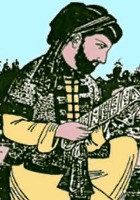
Ab'ul Hasan Yamin al-Din Khusrow (Persian: / Urdu ابوالحسن یمینالدین خسرو) better known as Amir Khusrow (or Khusrau or Khusro) Dehlawi was an Indian musician, scholar and poet. He was an iconic figure in the cultural history of the Indian subcontinent. A Sufi mystic and a spiritual disciple of Nizamuddin Auliya of Delhi, Amir Khusrow was not only a notable poet but also a prolific and seminal musician. He wrote poetry primarily in Persian, but also in Hindavi.
He is regarded as the "father of qawwali" (the devotional music of the Indian Sufis). He is also credited with enriching Hindustani classical music by introducing Persian and Arabic elements in it, and was the originator of the khayal and tarana styles of music.The invention of the tabla is also traditionally attributed to Amir Khusrow. Amir Khusrow used only 11 metrical schemes with 35 distinct divisions. He has written Ghazal, Masnavi, Qata, Rubai, Do-Beti and Tarkibhand.
A musician and a scholar, Amir Khusrow was as prolific in tender lyrics as in highly involved prose and could easily emulate all styles of Persian poetry which had developed in medieval Persia, from Khaqani's forceful qasidas to Nezami's khamsa. His contribution to the development of the ghazal, hitherto little used in India, is particularly significant.
He is regarded as the "father of qawwali" (the devotional music of the Indian Sufis). He is also credited with enriching Hindustani classical music by introducing Persian and Arabic elements in it, and was the originator of the khayal and tarana styles of music.The invention of the tabla is also traditionally attributed to Amir Khusrow. Amir Khusrow used only 11 metrical schemes with 35 distinct divisions. He has written Ghazal, Masnavi, Qata, Rubai, Do-Beti and Tarkibhand.
A musician and a scholar, Amir Khusrow was as prolific in tender lyrics as in highly involved prose and could easily emulate all styles of Persian poetry which had developed in medieval Persia, from Khaqani's forceful qasidas to Nezami's khamsa. His contribution to the development of the ghazal, hitherto little used in India, is particularly significant.
Ameer Khusro’s spiritualism, in fact, consisted in his philosophy of love, which he shared with all the Sufis. The depth of humanism in his poetry springs from that source of ‘Divine love’. He has composed as many as 99 works and four lac lyrics, which cover almost every aspect of life. He was a living legend. He was more of a qalandar (a free soul), though not less of a Sufi, Khusro’s humanism transcended all barriers of cast, colour and creed. In an autocratic age, when the king’s wilful actions were unrestricted, Khusro had the courage and the intrepidity to speak before the king, of the value of the equality of the man.
"Though my value may be, a little less, than that of yours yet, if your veins were to be cut open, our blood will come out of the same colour."
"Though my value may be, a little less, than that of yours yet, if your veins were to be cut open, our blood will come out of the same colour."
Khusro not only upheld the values of equality and dignity of labour but also the principles of social justice. His love and respect for Hazrat Nizamuddin Aulia reached the apogee that when he heard about his death at Lakhnawati, he immediately arrived and went to his grave, where he blackened his face and rolled over in dust in utter grief, tearing his garments. Six months after that event, he died on Friday 29th Ziq’ad 725AH/1325. His death is not a death in the literal sense of the world for, he would always remain one of the very few unforgettable legends of literature.
Comments
Post a Comment